Arrhythmia recognition practice quiz - heart rhythm test
 Written by William Entriken
 Reviewed by Jessica Munoz DNP, RN, CEN
Changes: Added new image and updated questions to improve clarity.
about 3–5 minutes
Question 1 of 9
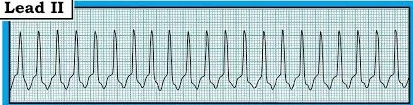
You place him on the cardiac monitor and it shows the following. Your diagnosis is
Question 2 of 9
Which drug should be given to this patient first?
Question 3 of 9
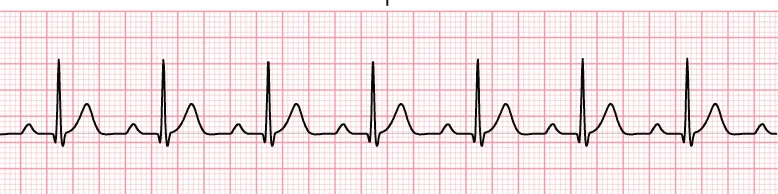
Suddenly, while you are preparing the drug, the patient says he feels much better. You look at the monitor and it reveals the following. This rhythm is
Question 4 of 9
At this point, the proper immediate care of this patient is
Question 5 of 9
The following rhythm is

Question 6 of 9
Which of the following is true In reference to the above rhythm?
Question 7 of 9
The following rhythm is
Question 8 of 9
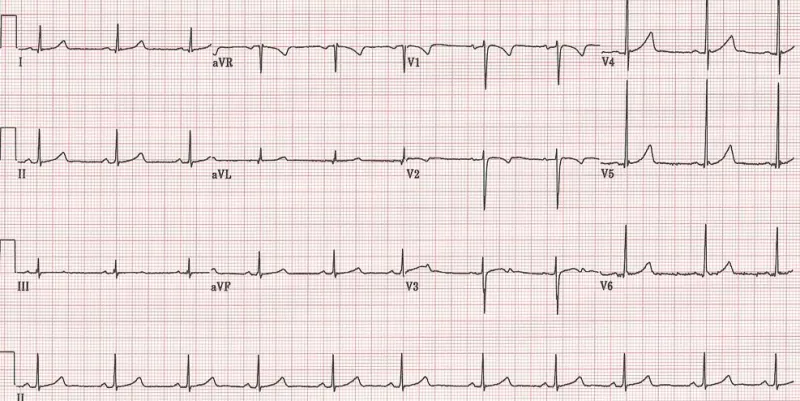
The following rhythm is
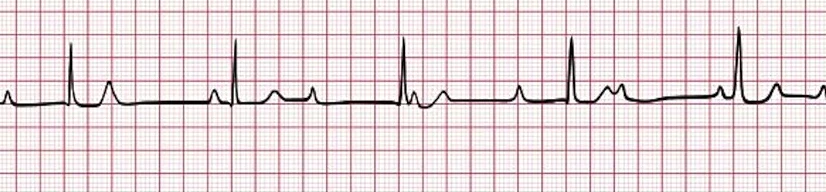
Question 9 of 9
Which of the following is true in this rhythm?
Get an email copy of your results now, and a reminder when you need to recertify:
Please provide email address.
Please verify or enter a different email address:
You scored #%
Correct answers
- Supraventricular tachycardia (SVT).
- Adenosine
- Sinus rhythm with a first-degree AV block.
- If vital signs remain stable, monitor the patient closely for a change in rhythm.
- Ventricular fibrillation.
- The above rhythm represents cardiac arrest
- Atrial fibrillation.
- Third degree AV block
- The P waves have no association with the QRS waves
How we reviewed this article
Our experts continually monitor the medical science space, and we update our articles when new information becomes available.
- Current versionMail the author of this pageEmail
- Sep 6, 2026
Copy edited by:
Copy editorsChanges: Added new image and updated questions to improve clarity.- Aug 24, 2026
Reviewed by:
Jessica Munoz DNP, RN, CEN Jessica Munoz is a registered nurse and educator with 20 years of experience in critical care emergency nursing, specializing in patient care, education, and evidence-based practice. She holds multiple certifications and serves as a Patient Safety Coordinator.- Nov 25, 2014
Written by:
William Entriken V.P., General manager of Pacific Medical Training and is ultimately responsible for keeping the customers happy and coming back, growing the business and keeping the team going.