Block - ECG case study
 Written by Judy Haluka
 Reviewed by Caitlin Goodwin DNP, CNM, RN
Changes: Fix formatting of the rhythm strip
A 76-year-old female comes to the emergency department begrudgingly after “nearly passing out while doing the dishes.” Her son, who accompanies her, says that she has been “getting dizzy off and on when she walks.” She currently has no complaint. Her past medical history includes myocardial infarction x 2, chronic obstructive pulmonary disease (COPD), and “some heart rhythm problem.” Her medications include warfarin, digoxin, lisinopril, metoprolol and levothyroxine.
Her physical exam is as follows:
- Skin: Pale, warm and dry
- Lungs: Rales in the posterior bases with some minor expiratory wheezes
- Pulse Oximetry: 94% on room air. She denies shortness of breath
- Extremities: 2+ pitted edema of both ankles.
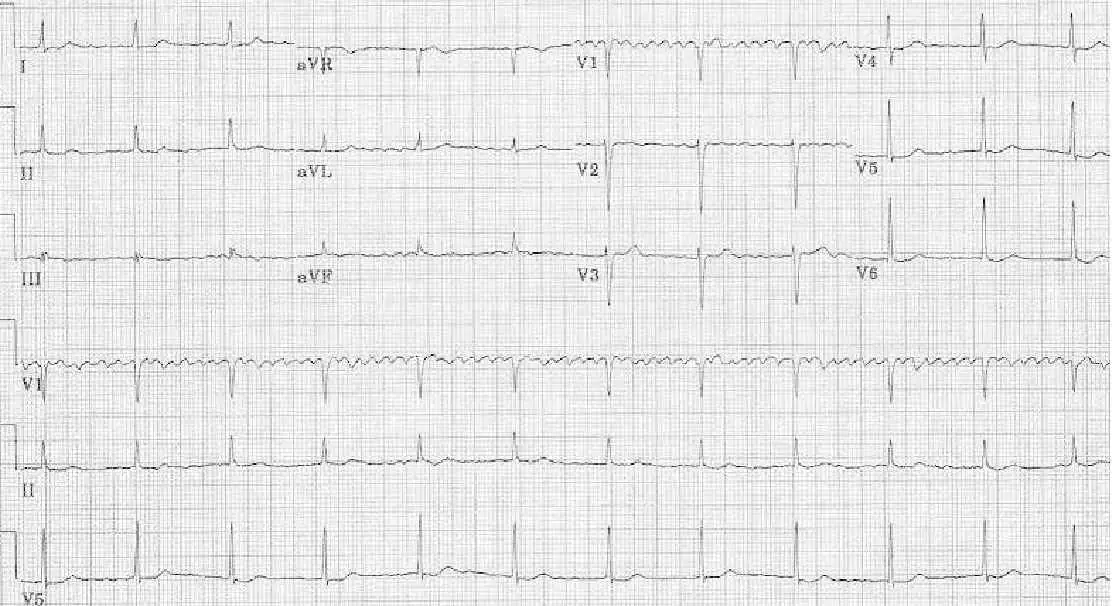
What does this ECG reveal and what do you suspect is the cause?
Discussion
Think digoxin. Digoxin slows conduction through the AV node. In the case of Digoxin toxicity, it can block conduction through the AV Node resulting in complete heart block. This case is an example of atrial fibrillation with complete heart block. Normally, you see an irregular ventricular response with atrial fibrillation because the AV node lets impulses through haphazardly resulting in irregular depolarization of the ventricles. In this case, the AV node is completely blocked. When one pacing system fails, the secondary pacemaker or the backup system kicks in. In this case that is the Junction (junctional rhythm). However, just because the AV node is shut down does not mean that the atrium stops fibrillating. Therefore the fibrillation waves of atrial fib can be seen clearly on the ECG.
The result is atrial fibrillation with complete heart block, which results in a perfectly regular rhythm.
Test your knowledge
Stay on track!
Would you like a reminder when your ACLS certification expires, plus study tips?
How we reviewed this article
Our experts continually monitor the medical science space, and we update our articles when new information becomes available.
- Current versionMail the author of this pageEmail
- Jan 14, 2023
Copy edited by:
Copy editorsChanges: Fix formatting of the rhythm strip- Nov 29, 2021
Reviewed by:
Caitlin Goodwin DNP, CNM, RN Caitlin Goodwin, DNP, RN, CNM, is a Board Certified Nurse-Midwife, Registered Nurse, and freelance writer. She has over twelve years of experience in nursing practice.- Sep 28, 2015
Written by:
Judy Haluka Judy has helped write or review several medical publications for us. Everything that she works on will clearly include Judy’s name.