Study guide to body systems: ACLS certification resource
Ahmed Raza
 Written by Amanda Menard, LPN, a practical nurse since 2005 with experience in ICU, cardiac care, and case management. She is pursuing her MSN for Family Nurse Practitioner and is a former Military Medic with the Louisiana National Guard.
 Reviewed by Lorraine Anne Liu, RN, a registered nurse and cum laude graduate with experience in OR, ICU, delivery room, and OPD. She specializes in pediatric care and primary health care nursing and is certified in BLS, IV therapy, and cardiac assessment.
Changes: Updated reference links throughout article
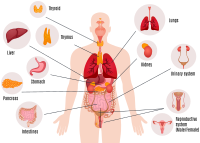
Have you ever wondered how your food is digested, or how you can breathe, or even move your arms? If you think about it, it’s pretty amazing that the human body can do all of these things and more. These actions are made possible by what is called organ systems which are collections of organs, body parts, and tissues that work together for a common goal. For example, each one of your bones is part of the skeletal system; they work collectively to provide support and movement so that you can walk and run. Your bones also work together to protect your important internal organs, such as the heart, lungs, and brain. Other organ systems present in your body are the circulatory, respiratory, muscular, digestive, integumentary, endocrine, reproductive, and nervous systems. All of these systems have specific functions but they cannot function independently. They rely on all the other systems in order to work properly. Each system is very important and every person has them. Below you will find a brief overview of each body system along with helpful educational links for adults and instructional links for teachers.
Circulatory system
The circulatory system consists of the heart and blood vessels which encompass all of the arteries, veins, and capillaries. The arteries carry oxygenated blood away from the heart, and veins return deoxygenated blood back to the heart. The main purpose of the circulatory system is to transport blood, oxygen, nutrients, and hormones to and from different cells and tissues throughout the body. This system works hand-in-hand with the respiratory system to facilitate the exchange of oxygen and carbon dioxide within the blood per the alveoli in the lungs. It is also very important for the removal of wastes and poisons within the body via the digestive and urinary systems.
- Project heart kids — Circulatory system: A neat animation of how the circulatory system works.
- Your cardiovascular system: Kids who are interested in learning more about the cardiovascular system and what it is can click on this link. On this page, readers will learn more details about the heart, the bloodstream, and how blood gets its oxygen!
- A printout sheet of the human heart: This page opens up to a printout of the human heart that can be colored. The printout has various parts of the heart labeled.
- Introduction to the circulatory system: A series of lesson plans for learning about the circulatory system. Blood vessels and how to check one’s pulse are a part of the lesson plans provided.
- Sail the circulatory system game: Play this game to learn more about the circulatory system.
Respiratory system
The respiratory system primarily consists of the trachea, bronchi, bronchioles, alveoli, lungs, and diaphragm. Its primary functions are to absorb oxygen through the inhalation (inspiration) of air and to expel carbon dioxide back out into the atmosphere through exhalation (expiration). This process is commonly called ventilation, otherwise known as breathing, which facilitates the exchange of oxygen and carbon dioxide between the lungs and atmosphere. Within the lungs, oxygen and carbon dioxide are exchanged via the alveoli, which are tiny air sacs where this action takes place. During this process, the newly oxygenated blood is pumped through the circulatory system by way of the heart to all of the cells, tissues, and organs throughout the body.
- The respiratory system:Educational information provided by the NIH. Includes an overview of the respiratory system, what happens when you breathe, what controls your breathing, and lung diseases and conditions.
- Inner body: Respiratory system: Includes 2D and 3D interactive respiratory system anatomy explorer. Provides information on each section of the respiratory system and an overview of how it all works together.
- Respiratory system: Teacher’s Guide (K–2) Free lesson plan materials on the respiratory system for early grades.
- Kidz search encyclopedia: Respiratory system: Information about the respiratory system in an easy to understand format. Provides educational information on the respiratory system basics, including breathing, gas exchange, and cellular respiration.
Skeletal system
The skeletal system consists of 206 bones in total and consists of several different types of bones such as long, short, flat, irregular, and sesamoid. It also consists of all the joints, cartilage, tendons, and ligaments within the body. The primary functions of the skeletal system are locomotion, support of the body, and the protection of internal organs such as the brain, heart, and lungs. Bones are also responsible for the production of red blood cells, platelets, and most white blood cells. Minerals such as calcium, iron, magnesium, and phosphorus are also stored within the bones, with 99% of the body’s calcium being stored here.
- Human skeletal system: Learn about the skeletal system components, types of bones, and types of joints.
- Learn the skeletal system: Label the bones: An interactive game for grades 4 and 5 that allows kids to label the various bones of the skeletal system.
- Human body: Human skeleton printout: Kids can ask their parents to print out this skeleton for coloring, or it can be colored online. Spaces are available for labeling the various parts.
- Skeleton match activity: Learning about the common and proper names of bones can be fun. Print this PDF and connect the common names of the bones with the proper names.
- The skeletal system: Read about the three major jobs that the skeletal system does. This link also tells how many bones there are in the human body.
Muscular system
The muscular system consists of 650 skeletal, smooth (visceral), and cardiac (myocardium) muscles. The primary functions of this system are movement, joint stabilization, heat generation, maintenance of posture, and the facilitation of blood circulation. Skeletal muscles connect to the bone and work hand-in-hand with the skeletal system to control voluntary movement such as walking and running. Smooth muscles are involuntary muscles that are responsible for the contraction of hollow muscles which include the stomach, intestines, bladder, and uterus. Cardiac muscle is an involuntary muscle found only in the heart and facilitates the circulation of blood by pumping it to the major arteries and out into the body via the circulatory system.
- Muscular system: Facts, functions, and diseases: Provides an educational overview of the human muscular system. Includes brief information about diseases of the muscular system.
- Kids health: Your muscles: Easy to understand educational overview of the muscular system.
- Inner body: Muscular system: Provides more in-depth information about the muscular system. Includes a 2D and 3D interactive anatomy explorer.
- Muscles topic overview A short animated overview and activities about muscles.
The digestive system
The digestive system consists mainly of the gastrointestinal (digestive) tract which includes the mouth, esophagus, stomach, small intestine, and large intestine (colon). The liver, gallbladder, and pancreas are also a part of this system and are responsible for contributing to the chemical breakdown of ingested food. The main functions of the digestive system are digestion, absorption, and the elimination of waste. Digestion is the breakdown of foods by mechanical and enzymatic processes into substances that can be utilized by the body. Absorption occurs primarily in the small intestine and is the process by which vitamins, minerals, carbohydrates, fats, and proteins are passed on to the blood for energy. Undigested and non-useful nutrients from food pass through to the large intestine and are eliminated as waste. The large intestine is also where the majority of water and sodium is absorbed into the body for use.
- Your digestive system and how it works: A more in-depth look at how the digestive system works, why it’s important, and what happens to your food as it passes through the digestive system.
- Kids health: Digestive system:Click on this link for a neat video about the digestive system.
- Science bob: The digestive system: Learn about the nine basic steps that the human digestive system goes through.
- Digestive system animation: A video that shows how the digestive system works for kids in grades 3 to 12.
Nervous system
The nervous system is made up of two major parts: the central nervous system (CNS) and the peripheral nervous system (PNS). The central nervous system is made up of the brain and spinal cord and acts as the main control system for the body. The peripheral nervous system is made up of all the nerves and ganglia (nerve cell clusters) found outside of the central nervous system; its role is receiving information from various stimuli and sending it to the brain. The main purpose of the nervous system is perceiving information from inside the body and/or from the external environment (PNS) and determining how the body responds to any changes (CNS). An example of this would be pricking your finger on a needle, your body will immediately pull your finger away in direct response to painful stimuli. This system also regulates basic bodily functions such as breathing, blood pressure, digestion, and the control of body temperature.
- How does the nervous system work?: Educational overview of the nervous system from the NIH.
- Modeling the nervous system: Make a neuron out of clay by following the instructions found on this page. The directions for the model are for kids in third grade through 12th grade.
- Brain and nervous system: Provides easy to understand information for kids about the nervous system. Includes a slideshow on the different parts of the brain, anatomy of the nervous system, how it works, and illnesses of this system.
- The human body systems for kids: On this page, kids can learn all about the various body systems. The last system covered by this PDF document is the nervous system.
Endocrine system
The endocrine system is primarily made up of the hypothalamus, thyroid, parathyroid, pituitary, pineal body, adrenal glands, pancreas, and reproductive glands. The main function of this system is to help regulate and maintain assorted functions of the body by releasing hormones into the bloodstream to maintain homeostasis. Homeostasis is the condition of maintaining balance within the body in relation to its external environment and is vital for life. Hormones are chemical substances produced by a gland, or glands, to affect other parts of the body. Together these glands are responsible for growth and development, breathing and heart rate, reproduction, metabolism, mood, sleep, tissue function, digestion, the release of insulin, and much more.
- Endocrine glands: Provides video addressing each endocrine gland within the body, how it works, and where the glands are located. It also provides an overview of the endocrine system.
- Teens health: Endocrine system: Provides educational information for teens regarding each gland and the hormones they produce. Includes an overview of the endocrine system along with common disease conditions.
- Activity: Endocrine system: Printable activity sheet for labeling the endocrine glands.
- Kidz search encyclopedia: Endocrine system facts: Includes educational information on the endocrine glands, the hormones they secrete, and where they are located.
- Hands-on activity: Endocrine excitement: Activity plan for teachers. This game teaches students about the hormone-receptor interactions within the endocrine system.
Integumentary system
The integumentary system consists of the skin, sweat and oil glands, nails, and hair. Skin is the largest organ in the body and is made up of three layers: the epidermis, dermis, and subcutaneous tissue. This system performs several functions that are vital to maintaining homeostasis. These functions are: protecting the body’s internal organs and tissues; protection from dehydration by helping to retain body fluids; protection from infectious organisms; maintaining a body temperature that is consistent with life; receptor site for pressure, sensation, pain, and temperature; excretion of waste materials through sweating; storing fat, water, and glucose; production of vitamin D. Hair is responsible for helping to protect the skin from ultraviolet radiation, while nails help to protect from injury and provide support for the tips of the fingers and toes.
- Physiopedia: Integumentary system: Provides general information about this system including the structure of the skin and the different layers. An educational video about the integumentary functions and anatomy is also included.
- Kids health: Your skin: Educational information about each layer of the skin in an easy to understand format.
- What’s covering you? And why?: Lesson plan for teachers that encourages learning about the four functions of the skin.
- Diagram of the human integumentary system: Infographic diagram on the human integumentary system. Also contains basic information about this system.
Urinary/excretory system
The urinary system is made up of the kidneys, ureters, bladder, and urethra. The kidneys filter and remove extra fluid, toxins, and waste from the bloodstream in the form of urine. Every day this system produces at least 1 to 2 quarts of urine. Other primary functions of the urinary system are maintaining the body’s relative state of homeostasis by keeping the levels of electrolytes in balance, producing hormones that regulate blood pressure, producing red blood cells, and helping to keep bones healthy by maintaining the right amounts of phosphorus and calcium within the body.
- The urinary tract and how it works: Educational information from the NIH about this system and its functions.
- Anatomy of the urinary system: Provides anatomical information about each organ within the system.
- Kids health: Your urinary system: Provides information about this system to kids in an easy to understand format.
- How the urinary system works: Educational and funny video for children about the urinary system and how it works.
- It may be yucky, but someone has to teach it…: Teacher’s lesson plan and activity on the excretory system geared toward elementary school students.
Lymphatic system
The lymphatic system consists of the lymphatic vessels, tonsils, adenoids, spleen, and thymus gland. Lymphatic vessels are similar to the circulatory system’s capillaries and veins and are connected to hundreds of lymph nodes within the body. Lymph nodes produce and store the cells that fight infection and disease. Tonsils take in bacteria and viruses that enter through the mouth and nose and are considered the first line of defense for the immune system. The spleen is the largest lymphatic organ and is responsible for producing both red and white blood cells and helps to detect dangerous microorganisms, viruses, and bacteria within the blood. As part of the immune system, the primary function of the lymphatic system is to transport a clear and colorless infection-fighting fluid called lymph, which contains white blood cells, throughout the body via the lymphatic vessels. Other functions of this system are absorbing fats and fat-soluble vitamins from the digestive system and transporting them into the bloodstream, restoring excess proteins and interstitial fluids to the blood, and helping to rid the body of toxic byproducts.
- Your immune system: Information from the CDC about each organ in the lymphatic system, where it is found, and what they produce.
- Teens health: Spleen and lymphatic system: Provides information about the basic anatomy of the lymphatic system, how it works, and disease conditions associated with this system.
- Lymphatic system: Crash coourse: Educational and funny video about the lymphatic system. Provides a transcript of the video for the hearing impaired.
- Immune system defender: Fun interactive and educational online game for children.
Reproductive system
The reproductive system in men consists of the penis, scrotum, and testicles, and in women it consists of the ovaries, fallopian tubes, uterus, vagina, breasts, and mammary glands. Together there are four main functions of the reproductive system: the production of hormones such as testosterone, progesterone, and estrogen; the production of egg and sperm cells; the sustenance and transportation of these cells; and the development and nurturing of offspring. This system is vital to the survival of the human species by creating new life.
- Reproductive system organs: Overview of descriptions and functions of the male and female reproductive organs.
- Teen health: Male reproductive system: Provides educational information for teen boys about the male reproductive system in an easy to understand format.
- Teen health: Female reproductive system: Provides educational information for teen girls about the female reproductive system.
See also our heart anatomy chart for specific information on the heart. Check our 100% online and accredited ACLS course for getting certified.
Test your knowledge
Stay on track!
Would you like a reminder when your ACLS certification expires, plus study tips?
How we reviewed this article
Our experts continually monitor the medical science space, and we update our articles when new information becomes available.
- Current versionMail the author of this pageEmail
- Oct 29, 2025
Copy edited by:
Copy editorsChanges: Updated reference links throughout article- Sep 17, 2025
Written by:
- Jul 6, 2020
Reviewed by: